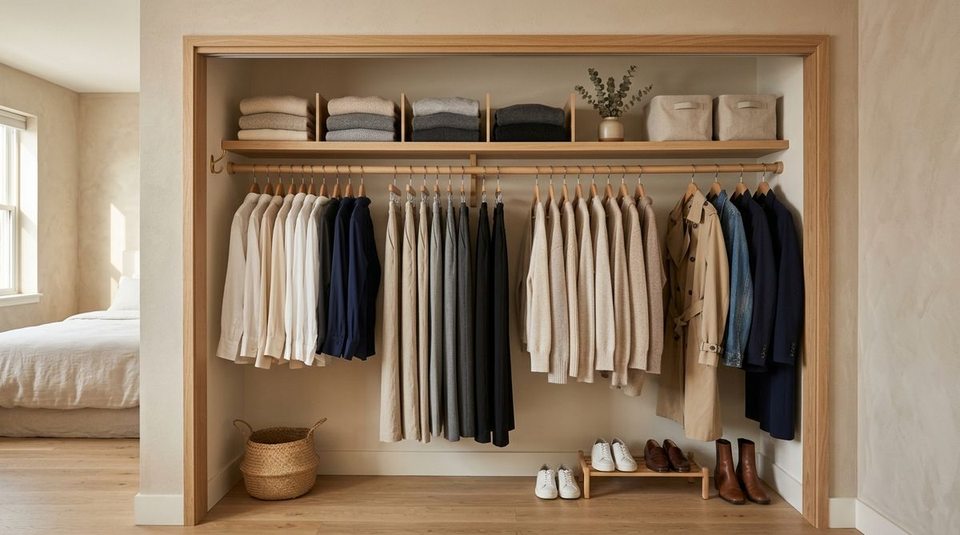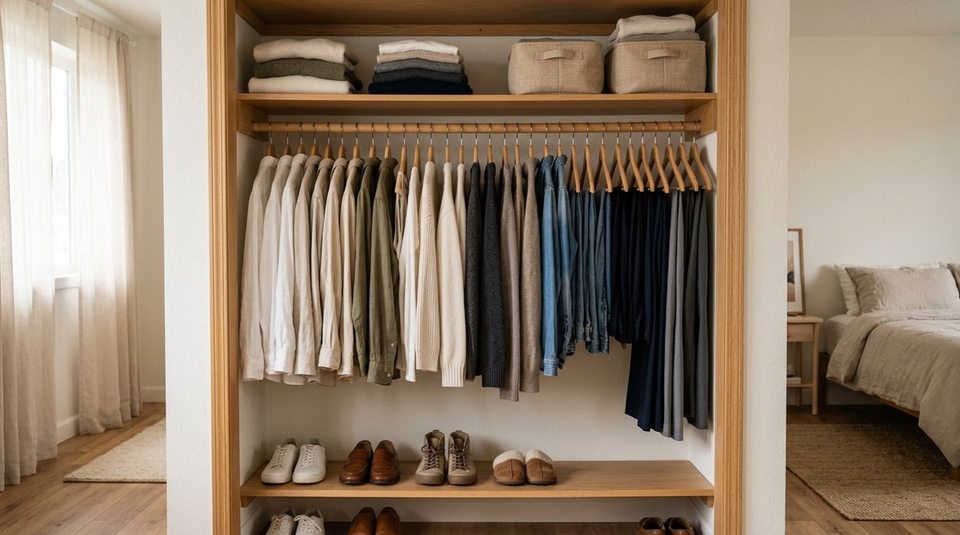
You can spend an entire Saturday color-coordinating your shirts, matching every hanger, and folding every sweater into pristine piles, and still find yourself standing in front of your wardrobe on Tuesday morning feeling frustrated and overwhelmed.
Most traditional closet organization advice assumes that the secret to getting dressed easily is arranging clothes by visual symmetry, garment category, or color gradients. You group every dress together, hang all jackets in a row, and place your blazers in prime eye-level territory because they look structured and impressive on the rail.
Yet if you work remotely four days a week and spend weekends in comfortable linen shirts and casual denim, organizing around structured blazers creates an immediate mismatch between how your wardrobe is organized and how you actually live.
The solution is not another aggressive weekend decluttering spree. The solution is adopting a lightweight behavioral framework: observe your real wearing behavior before reorganizing. By running a simple Wear → Note → Compare → Adjust audit, you learn to let real-world daily habits dictate your storage layout—creating a wardrobe that supports your actual life with effortless ease.
Why a Neat Closet Can Still Work Poorly
There is a fundamental difference between visual neatness and functional efficiency. A closet can look like a high-end boutique display and still introduce friction every single morning.
When storage layouts are built purely on aesthetic rules or idealized assumptions about our lifestyle, several daily obstacles emerge:
- The Aspirant Wardrobe Bias: Organizing around clothes you think you should wear (e.g., formal dresses or crisp button-downs) rather than the comfortable, reliable layers you reach for on 80% of days.
- Access Bottlenecks: Forcing your daily t-shirts into deep lower drawers while seldom-worn formal coats occupy prime eye-level hanging space.
- Decision Fatigue: Scanning through dozens of untouched items every morning just to find the four staple pieces you consistently rotate between.
- Rebound Disorganization: Pulling daily essentials from awkward, cramped corners eventually disrupts the rest of the neat shelves, causing clutter to rebuild.
Understanding that functional organization must follow human behavior rather than showroom symmetry is the first step toward lasting wardrobe peace.
What Is a Closet Wear Audit?
A Closet Wear Audit is a low-effort, multi-day observation period where you pay attention to the clothes you naturally choose to wear before attempting to change a single hanger or shelf.
To understand the system, it helps to clarify what a wear audit is not:
- It is NOT a decluttering challenge: You are not being pressured to purge half your clothes into donation bags.
- It is NOT a fashion critique: There are no rules about what you "should" be wearing.
- It is NOT a capsule wardrobe restriction: You do not need to limit yourself to an arbitrary number of garments.
Instead, a wear audit is an objective decision-making tool that reveals how your current storage setup either helps or hinders your daily routine.
Why Observe Before You Reorganize?
When people decide to reorganize their closet, they almost always begin by pulling everything out onto the bed and rearranging pieces based on assumptions.
The flaw in rearranging first is that you simply recreate the same biases in a different layout. You assume that your slacks need the main hanging bar, or that all sweaters should live together on a high shelf, without testing whether that arrangement actually serves your mornings.
Observing first provides concrete evidence. A 7-day observation period can reveal valuable patterns about your true habits—showing you which pieces are your true workhorses and where your storage layout is creating unnecessary daily friction.
Step 1 — WEAR Normally
During the first phase of the audit, the golden rule is to change absolutely nothing about how you dress or store your clothes.
Do not try to impress yourself by wearing pieces you haven't touched in two years. Do not force artificial variety into your outfits. Get dressed exactly as you normally do for your actual meetings, errands, family routines, and relaxation.
Each morning as you reach into your closet, simply ask yourself one grounding question:
"What did I naturally reach for today?"
Step 2 — NOTE the Patterns
Observing your wardrobe should never become an exhausting chore or require complex spreadsheets. Keep your tracking effortless and intuitive.
Throughout the week, make casual mental notes (or jot 3-word bullet points in your phone) about four key patterns:
- Repeated Favorites: Which 2–3 pairs of pants, shirts, or layering pieces did you reach for multiple times?
- Untouched Rows: Which entire sections of your hanging rail did your eyes glide over without a second thought?
- Go-To Combinations: Which pieces do you naturally pair together as an automatic uniform?
- Physical Friction Points: Did you have to push past five heavy blazers to retrieve the simple cardigan you wear every morning?
Step 3 — COMPARE What You Wear With Where It Lives
At the end of your observation period, conduct a 5-minute spatial comparison. Look at your closet and evaluate the relationship between usage frequency and storage placement.
Ask yourself these four diagnostic questions:
| Diagnostic Question | What It Reveals | Target Adjustment |
|---|---|---|
| Are daily essentials easy to reach? | High-wear pieces hidden in inconvenient spots | Shift to eye-level hanging or top drawer |
| Are rare items taking prime space? | Formalwear or occasional gear crowding daily racks | Relocate to outer closet edges or high shelves |
| Do you repeatedly ignore entire zones? | Clothing categories misaligned with current lifestyle | Consolidate or secondary-archive those sections |
For more insights on setting up functional heights, see our guide on how to organize a rental closet without drilling.
Step 4 — ADJUST Only What the Audit Supports
The most common mistake after an audit is overreacting and tearing down the entire wardrobe. Practice intentional restraint.
Make only small, targeted micro-adjustments directly justified by your observations:
- If you noticed you wear knit sweaters three days a week, move them down from a high shelf to an easy-access open shelf.
- If formal suits occupied the center of your hanging rod but went untouched, slide them to the far left corner.
- If your favorite casual t-shirts were crammed into a tight bottom drawer, swap their placement with seldom-used sportswear.
By letting real behavioral data guide each shift, you build a system that stays functional long term.
What the Audit Can Tell You
When you observe your habits with curiosity rather than judgment, a wear audit reveals clear, actionable insights:
- Your Real Uniform: The 10–15 core garments that form the true foundation of your weekly routine.
- Hidden Access Barriers: Pieces you genuinely love but avoid wearing simply because they are stored behind awkward doors or tight corners.
- Category Oversizing: Realizing you own twenty button-down shirts but only ever rotate between the same four neutral favorites.
- Routine Evolution: Recognizing that a past wardrobe from a previous job or lifestyle no longer matches your current day-to-day needs.
What the Audit Cannot Tell You
Honest organization requires recognizing the limitations of a short observation window. A 7-day wear audit cannot determine:
- The Complete Value of Every Garment: A rarely worn trench coat or formal cocktail dress is not "useless" just because you didn't wear it on a random Tuesday in October.
- Four-Season Utility: Summer dresses will naturally sit idle during an autumn audit, and heavy wool coats will go untouched in June.
- Special-Occasion Readiness: Black-tie attire, interview suits, or hiking gear serve vital purposes despite low wearing frequency.
Never treat a weekly audit as an automatic mandate to throw away clothes. It is an arrangement diagnostic—not a purge tribunal.
Don't Confuse Low Wear With Low Value
One of the healthiest principles in modern wardrobe management is separating frequency of use from utility and personal value.
"The audit asks: 'How often do I reach for this?'
It does not ask: 'Should I get rid of this?'"
Items with low wear but high value simply need secondary storage placement. Hang formal garments in protective garment bags on the perimeter of your closet, or store occasional gear on higher shelves. They remain safe and accessible without cluttering your daily morning flow.
How to Turn Observations Into Better Closet Decisions
To translate your audit into a streamlined closet, apply this simple decision rule whenever deciding where a garment belongs:
- High Wear (Worn Weekly): Place directly at eye level and in the center 50% of your hanging bar or primary drawer.
- Moderate Wear (Worn Monthly): Position on outer edges of the hanging bar or secondary drawer tiers.
- Low Wear / High Value (Occasional): Store on top shelves, in storage bins, or in back closet corners.
- Low Wear / Low Value (Unworn & Uncomfortable): Set aside in a temporary basket to evaluate for future donation when you're ready.
For elevated aesthetic rules that complement this functional flow, explore our guide to 5 closet rules that make any closet look expensive.
A Simple 7-Day Wear Audit
Follow this straightforward timeline to complete your first behavioral closet check:
Days 1 to 6 (The Observation Phase):
✓ Get dressed completely normally.
✓ Make mental notes of repeated favorites and untouched sections.
✓ Note any physical friction when reaching for daily clothes.
Day 7 (The Evaluation & Adjustment Phase):
✓ Compare your most-worn items against their physical closet placement.
✓ Move 3 to 5 high-wear items into more convenient, prime-access spots.
✓ Shift low-wear items away from prime center real estate.
✓ Leave the rest of the closet untouched and test the new flow for the upcoming week.
When to Repeat the Audit
A wear audit is an adaptable tool you can deploy whenever your lifestyle shifts. It is particularly helpful to repeat during:
- Seasonal Transitions: When shifting from spring/summer to autumn/winter wardrobes.
- Career or Schedule Changes: Transitioning between remote work, hybrid schedules, or office settings.
- Moving to a New Space: Adapting to a different closet depth or layout in a new apartment.
- Wardrobe Resets: Whenever mornings start feeling stressful or cluttered again.
To avoid common layout traps when arranging small spaces, read our review of 5 closet mistakes making your closet feel smaller.
What NOT to Change After the Audit
To ensure your reorganization remains sustainable, maintain clear boundaries around what you avoid changing:
- Do NOT buy new organizing bins immediately: Changing the physical position of garments is usually enough to solve 90% of friction.
- Do NOT reorganize garments that already work well: If your underwear drawer or sock basket functions smoothly, leave it alone.
- Do NOT force symmetry over practicality: If keeping your two most-worn jackets on the end hook makes your mornings seamless, keep them there regardless of color matching.
For more space-conscious ideas to streamline your wardrobe, explore our curated closet organization ideas.
Organize Around Your Real Life
An organized closet does not exist to impress anyone or match an idealized catalog photo. Its sole job is to make your mornings effortless, calm, and supportive of your real routine.
By using the Wear → Note → Compare → Adjust cycle, you replace guesswork and frustration with clear behavioral insights. You give your daily workhorse clothes the prime real estate they deserve, move occasional pieces into thoughtful secondary homes, and create a closet that works in complete harmony with how you actually live.