You can have a relatively tidy bathroom and still spend far too much time getting ready to clean it. The surface spray is tucked into a hallway closet. The microfiber cloth is in a kitchen drawer. The toilet brush is under the sink behind three bottles of shampoo, and the rubber gloves are wherever you last set them down.
Before you even wipe down a single faucet, you have walked to three different rooms and rummaged through multiple dark cabinets. That initial friction is often the main reason bathroom cleaning gets delayed.
The problem is rarely a lack of cabinet space or having too few organizers. The core issue is that bathroom cleaning supplies are almost always organized by whatever empty space was available, rather than around the actual cleaning tasks you perform.
The fundamental rule of effortless maintenance is simple: cleaning supplies should be organized around the task—not scattered around the room. When you implement a streamlined Grab → Clean → Return routine, keeping your bathroom fresh stops feeling like an exhausting chore and becomes a fast, frictionless habit.
Why Bathroom Cleaning Supplies Become Scattered
In most homes, cleaning supplies don't become disorganized out of carelessness. They become scattered because human storage habits tend to prioritize hiding individual bottles wherever they happen to fit.
This creates a predictable set of everyday problems:
- Fragmented Storage: Glass cleaner lives under the vanity, disinfectant lives in the laundry closet, and cloths live in the linen cupboard.
- Organizing by Geometry, Not Workflow: Tall bottles are shoved where height allows, while sponges are stuffed into leftover corners.
- No Defined Return Point: When a cleaner doesn't have a dedicated, single-motion home, it ends up sitting on the edge of the tub or behind the toilet after use.
- Accidental Duplication: Because you cannot see everything at a glance, you buy extra bottles of cleaner only to discover two half-used bottles buried in the back of a cabinet.
Recognizing these patterns is the first step toward building a system that naturally maintains itself.
Start With the Cleaning Task, Not the Storage Space
When organizing a small bathroom, the traditional question is: "Where can I fit these seven bottles?"
A task-based approach reverses that question entirely: "What small group of tools do I actually need to clean the sink, mirror, and toilet?"
Instead of thinking about all your cleaning chemicals as one massive inventory, break your routine into specific recurring actions:
- The 2-Minute Daily Wipe-Down: A quick wipe of the faucet, sink basin, and countertop.
- The Weekly Routine: Disinfecting the toilet, scrubbing the tub, and polishing the mirror.
- Specialty Maintenance: Grout detailing, descaling shower heads, or drain treatments.
By grouping supplies by the specific task they support, you eliminate the mental fatigue of gathering supplies one by one.
The Grab → Clean → Return System
To make bathroom cleaning virtually effortless to start and finish, use this 3-step cycle:
GRAB → CLEAN → RETURN
- GRAB: Pick up the single, self-contained kit that holds everything needed for the task in one easy motion.
- CLEAN: Carry the kit directly to the vanity or shower, complete the cleaning without stepping away to hunt for missing tools.
- RETURN: Place the entire kit right back into its designated home immediately when finished.
This workflow removes repeated searching, eliminates mid-task interruptions, and makes putting supplies away as fast as pulling them out.
Build a Small Bathroom Cleaning Kit
Building a task-based cleaning kit does not require buying a dozen specialty sprays or specialized gadgets. In fact, the most effective kits are remarkably compact.
A complete, highly functional everyday bathroom kit typically contains just four or five essentials:
- One multi-surface bathroom cleaner appropriate for your fixtures
- Two clean microfiber cloths (one for glass/mirrors, one for surfaces)
- One dedicated scrub sponge or detail brush
- A pair of reusable protective gloves
Note: Always use supplies that are safe for your specific surfaces and follow manufacturer labels carefully. Never combine different cleaning chemicals.
What Belongs in the Kit?
To prevent your cleaning kit from becoming another cluttered catch-all basket, test every candidate item against four strict questions:
- Do I use this item every single time I clean this bathroom? (If you only use it once every three months, it belongs in secondary storage).
- Does having it in the kit save me from walking to another room?
- Does it fit comfortably without overflowing the container?
- Does it have a safe, upright resting position that prevents leaks?
Keeping the kit lean ensures that it remains lightweight, portable, and easy to grab with one hand.
Where Should the Cleaning Kit Live?
There is no universal storage location that works for every apartment layout. The right spot is the one that satisfies two conditions: easy to reach and safe from daily moisture.
Depending on your bathroom architecture, practical homes include:
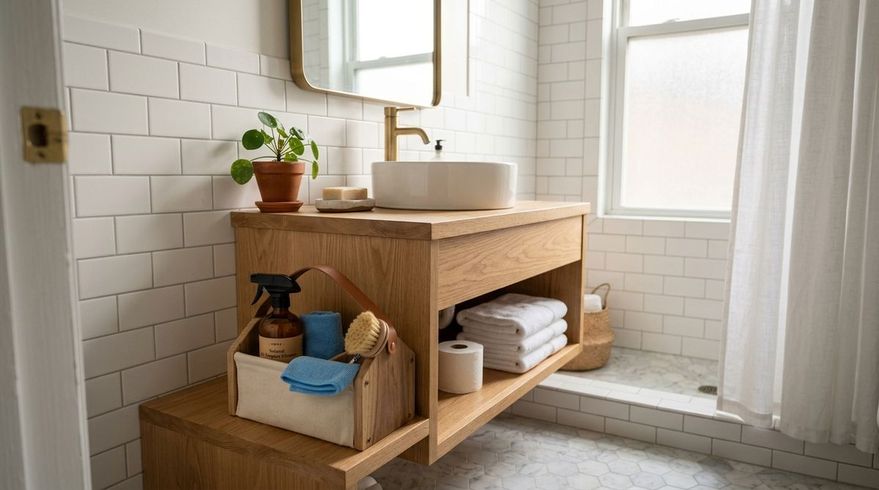
- The Under-Sink Base: Placing the caddy on the front ledge or a pull-out tray beside the plumbing pipes. For zoning tips around tricky pipes, our complete guide to bathroom under-sink and linen closet organization provides detailed layouts.
- A Narrow Freestanding Cabinet: Tucking the kit inside a slim floor unit beside the vanity or toilet.
- A Nearby Hall Linen Shelf: If your bathroom has zero vanity storage, dedicating the bottom shelf of a hallway closet immediately adjacent to the bathroom door keeps supplies accessible.
Wherever you place it, make sure the caddy can be lifted out without having to move toiletries or toilet paper rolls first.
Organize Supplies Around Frequency of Cleaning
Not every cleaning product needs prime, eye-level shelf space. Structuring your storage by frequency of use prevents overcrowding:
Routine Supplies (Weekly or Bi-Weekly)
Your primary surface spray, mirror cloth, and toilet cleaner. These live directly in your portable primary kit in your most accessible cabinet zone.
Occasional Supplies (Monthly)
Tile grout cleaner, tub descaler, or backup scrub sponges. These can live deeper in the under-sink cabinet or on higher closet shelves.
Special-Purpose Supplies (Annual or As-Needed)
Drain snakes, caulk cleaners, or heavy-duty restoration tools. These belong in general utility storage or a high utility shelf, entirely separate from daily bathroom routines.
Applying this hierarchy aligns with the Reach Zone Rule for small bathrooms, ensuring high-frequency tools never compete with occasional clutter.
Stop Creating Duplicate Cleaning Supplies
One of the hidden costs of scattered storage is accidental duplicate purchases. When a bottle of glass cleaner gets pushed behind a stack of towels, you assume you've run out and buy a replacement.
Before purchasing any new cleaner or organizing bin:
- Do a full, 5-minute sweep of every cabinet, under-sink cavity, and linen shelf.
- Gather all matching cleaners together and consolidate identical, open bottles where appropriate.
- Donate or safely dispose of specialty products you haven't used in over a year.
- Commit to a single "one in, one out" rule for each cleaning category.
Make the Return Easier Than Leaving It Out
Behavioral friction is the primary reason cleaning supplies end up stranded on countertops or left in the shower stall. If putting a spray bottle away requires bending awkwardly, unstacking bins, or squeezing past plumbing, you will leave it out on the counter.
To eliminate this friction:
- Never store your daily cleaning kit behind opaque, stacked boxes.
- Keep the path to the caddy completely clear of secondary toiletries.
- Ensure the storage container has an open top so bottles drop in smoothly in one second.
Easy return equals effortless maintenance. When putting an item away takes less physical effort than leaving it out, clutter simply does not form.
The 2-Minute Cleaning Kit Test
To test and refine your task-based cleaning system today, run this simple experiment:
✓ Step 1: Pick your single most frequent bathroom cleaning task (e.g., the vanity and mirror wipe-down).
✓ Step 2: Gather only the 3 or 4 tools you actually use for that exact job into a small container or basket.
✓ Step 3: Place that container in your most accessible cabinet spot.
✓ Step 4: The next time you clean, use only what is in the kit.
✓ Step 5: Return the entire container to its home immediately.
✓ Step 6: Notice whether the process felt smooth and fast. If you hesitated at any point, adjust the location before buying new storage products.
Renter-Friendly Bathroom Cleaning Supply Storage
Renters often have to work around pedestal sinks, shallow medicine cabinets, or vanities with zero drawers. In these spaces, non-permanent, damage-free storage strategies are essential:
- Portable Cleaning Caddies: A lightweight plastic or wooden caddy with a center handle that transports easily from cabinet to vanity.
- Freestanding Ultra-Narrow Cabinets: Utilizing the awkward 6-inch gap between a vanity and wall with a slim, enclosed floor unit that conceals supplies behind a clean door.
- Under-Sink Tension Shelves: Non-damaging expandable shelving that creates a sturdy flat surface above curved plumbing pipes.
If you have an unassigned narrow gap beside your vanity or toilet, a compact floor cabinet provides enclosed, renter-friendly storage for your cleaning kit and backup rolls.
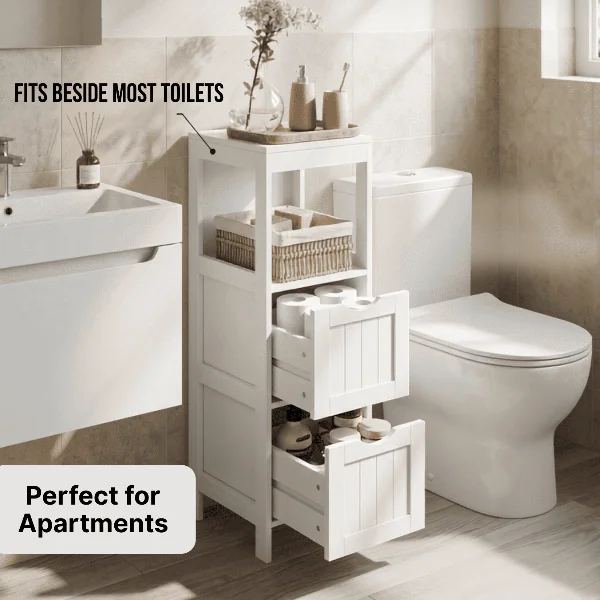
Narrow Bathroom Storage Cabinet
Solution: This ultra-slim freestanding cabinet slides into 6-inch gaps beside the toilet or vanity, providing hidden, waterproof vertical storage for cleaning supplies, sprays, and backup rolls.
- Fits into ultra-narrow 6-inch dead gaps beside bathroom fixtures
- Conceals cleaning sprays and scrub brushes behind closed doors
- Lightweight, moisture-resistant, and 100% renter-friendly
For more non-permanent ideas to upgrade tight spaces, explore our full review of bathroom organization solutions that fit compact apartment floor plans.
When You Don't Need a Cleaning Kit
Good organization is about practical simplicity, not adding unnecessary containers for the sake of aesthetics. You may not need a dedicated cleaning caddy if:
- Your bathroom is a compact powder room where only a single surface spray and cloth are ever needed.
- All cleaning supplies already live together in a single, perfectly accessible top vanity drawer.
- You share a central cleaning caddy stored in a central laundry or utility closet that services the whole apartment.
The goal is never to buy more bins; the goal is simply having a predictable, repeatable cleaning routine.
The One Task → One Kit → One Home Rule
When refining your home maintenance routines, anchor your system to this simple rule:
"One Task → One Kit → One Home."
- One Task: Clarify the exact cleaning job you are doing.
- One Kit: Gather only the specific supplies that support that action.
- One Home: Return those supplies to the exact same, frictionless spot every single time.
Keeping this boundary in place prevents items from wandering and ensures you never waste time preparing to clean.
How to Keep the System Working
To ensure your bathroom cleaning organization remains effortless over the long haul, practice these subtle maintenance habits:
- Immediate Return: Never leave the caddy sitting on the floor or vanity after the job is done; return it while your hands are still in cleaning mode.
- Quarterly Chemical Audit: Check bottle levels every few months and dispose of expired or separated formulas.
- Wash Cloths Regularly: Keep microfiber cloths clean and dry before tucking them back into the caddy to prevent musty odors.
- Adjust for Friction: If you notice a bottle getting left out repeatedly, check its storage spot. Reorganizing the cabinet usually solves the problem immediately.
Avoiding these friction points helps you prevent the 5 bathroom storage mistakes making your tiny bathroom look smaller.
The Goal Isn't More Cleaning Storage
A small apartment bathroom does not need an elaborate storage closet filled with dozens of specialized cleaning tools. What it truly needs is a simple, dependable system that gets out of your way.
By organizing your supplies around the tasks you actually perform and implementing the Grab → Clean → Return cycle, you remove the friction that makes cleaning feel daunting. You save time, protect your storage space, and create a calm, sparkling bathroom that is effortless to keep fresh every day.