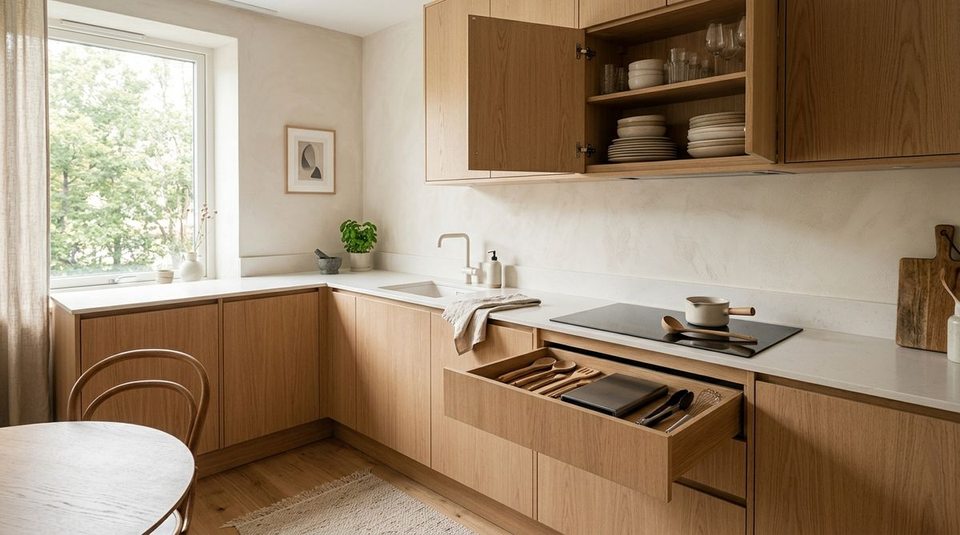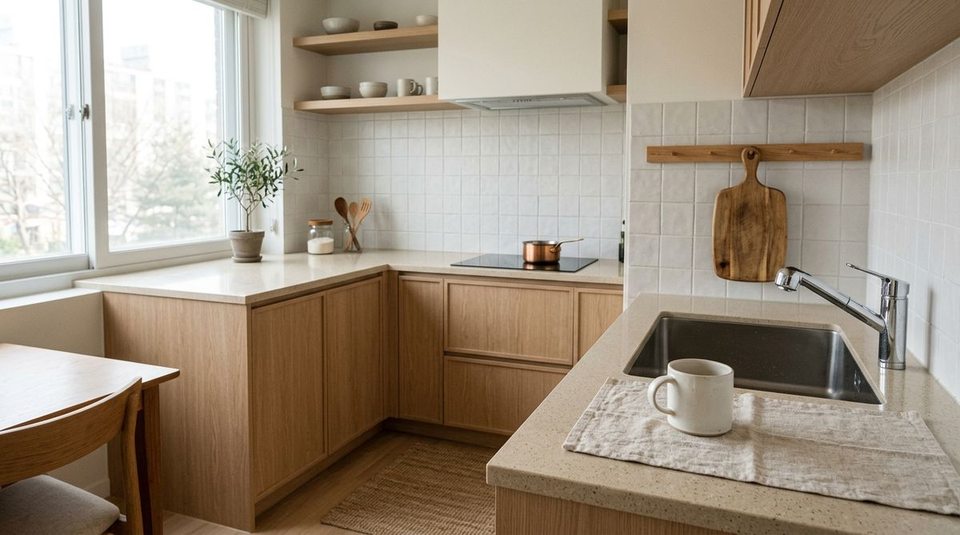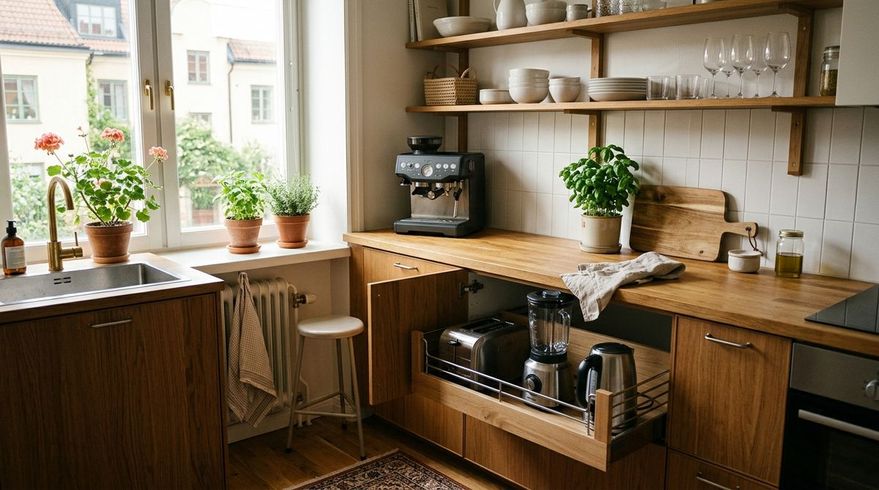
In a small kitchen, countertop space is your most valuable asset. It is where you chop vegetables, roll out dough, brew coffee, and unpack groceries. Yet in almost every compact apartment, countertops gradually turn into a crowded parking lot for blenders, toasters, air fryers, slow cookers, and stand mixers.
Every time you need to cook a simple meal, you find yourself sliding heavy machines around, balancing cutting boards on narrow slivers of wood, or working right on top of electric cords.
When this happens, most people assume they either need to throw away half their tools or buy an expensive rolling island. But successful small kitchen appliance storage is built on a different truth: the problem is rarely having too many appliances—the problem is that appliance access and storage locations do not match your actual daily routine.
The core principle of small-space cooking is simple: access should match frequency. When you create an intentional parking plan based on how often you truly use each tool, you can reclaim your prep counters without giving up the appliances that make cooking enjoyable.
Why Small Kitchen Appliances Keep Taking Over the Counter
Appliances don't migrate onto kitchen counters because renters are disorganized. They stay on the counter because human behavior always follows the path of least resistance.
There are four specific reasons appliances end up permanently stranded on your prep surfaces:
- The Storage Location Is Inconvenient: If grabbing the food processor requires kneeling down, reaching into the dark back of a lower cabinet, and lifting out three heavy mixing bowls first, you will simply leave it on the counter after using it.
- The Appliance Lacks a Defined Home: When an appliance doesn't have a designated shelf or spot, leaving it on the counter becomes its default resting place.
- Returning It Creates Friction: If putting a machine away requires wrapping complex cords, wrestling cabinet doors, or unpacking other items, you will delay putting it away until "later."
- Overestimating Prep Space: We often leave items out thinking "I'll probably use this tomorrow," slowly accumulating four or five machines that crowd out our workspace.
Tackling this problem is not about forcing yourself to have completely bare counters. It is about aligning where each machine lives with how frequently your household actually cooks with it.
The Problem Isn't Always Too Many Appliances
Minimalist kitchen guides often advise purging every gadget until you only own a single pot and a knife. But appliances like air fryers, blenders, and rice cookers save real time for busy households.
There is a fundamental difference between:
- Appliance Quantity: The total number of kitchen tools you own.
- Appliance Access: How easy it is to retrieve and use each machine.
- Appliance Storage: The physical volume and location where machines rest when not in use.
- Counter-Space Allocation: Which specific tools have earned the privilege of taking up your primary prep surface.
Some compact kitchens can comfortably keep two appliances on the counter full-time. Other galley kitchens need every square inch cleared for meal prep. The right balance depends entirely on how your kitchen routine functions day to day.
Start With Frequency of Use
Before moving a single cord or buying an organizer, categorize your appliances into four distinct tiers of actual use:
Daily (Used Almost Every Single Day)
Items like an electric kettle or drip coffee maker that you interact with every single morning. These items have the strongest justification for claiming valuable counter real estate.
Regular (Used 2 to 4 Times a Week)
Items like a toaster, high-speed smoothie blender, or compact air fryer. These tools need fast, effortless retrieval, but they do not necessarily need to dominate your primary cutting-board area.
Occasional (Used 1 to 2 Times a Month)
Items like a food processor, slow cooker, or hand mixer. These belong in accessible cabinet or pantry storage where they can be fetched in seconds without occupying daily prep space.
Rare (Used a Few Times a Year)
Items like a holiday roasting pan, stand mixer, ice cream maker, or waffle iron. These should be parked on top shelves, deep pantry corners, or secondary storage.
By sorting tools by real-world usage, you stop treating all appliances as equal and start allocating your kitchen space intentionally.
The USE → PARK → CLEAR → RETURN System
To keep countertops clear without making cooking frustrating, implement this simple 4-step cycle:
USE → PARK → CLEAR → RETURN
- USE: Pull out the appliance effortlessly when it is time to cook.
- PARK: Give the appliance a designated, predictable parking spot that matches its frequency tier.
- CLEAR: Once meal prep is finished and the appliance is wiped down, immediately clear the counter surface.
- RETURN: Return the machine to its assigned home smoothly because the storage spot is low-friction and unobstructed.
Any organization system will fail if returning an item is harder than leaving it out on the counter. The secret to long-term success is making the return effortless.
What Should Stay on the Counter?
How do you decide which appliances deserve permanent counter space? Rather than following arbitrary rules, evaluate each tool against this practical checklist:
- Daily Necessity: Do you use it every morning or evening without fail?
- Heavy Physical Weight: Is the machine so heavy (like an all-metal stand mixer or espresso station) that lifting it into a cabinet risks injury or damage?
- Setup Complexity: Does the appliance require complex water lines or calibration that makes packing it away impractical?
- Corner Footprint: Does it sit in an unusable corner nook that wouldn't serve as a prep station anyway?
If an appliance checks these boxes, keeping it out is completely justified. But if an item is only used twice a week and sits right where you chop vegetables, it is costing you more in daily frustration than it delivers in convenience.
What Should Be Stored Away?
An appliance should be stored inside a cabinet, shelf, or pantry if:
- It is used occasionally rather than daily.
- Its footprint consumes your primary meal prep zone.
- Grease splatters and dust accumulate on it while sitting near the stove.
- It is lightweight and easy to lift with one hand (like a toaster, immersion blender, or electric hand mixer).
- Storing it away instantly frees up a continuous stretch of clean counter space.
The goal is not an empty, sterile kitchen counter. The goal is intentional counter space that gives you room to cook comfortably.
Give Every Appliance a Real Home
When an appliance has a vague storage location—like "somewhere in the bottom cupboards"—it will inevitably end up back on the countertop. A genuine appliance home must satisfy four criteria:
- Direct Accessibility: You shouldn't have to unpack nested bowls or unstack pans to pull the machine out.
- Weight Appropriate: Heavy machines belong between waist and knee height on sturdy shelves, not overhead where lifting is dangerous.
- Cord Containment: The power cord should be bundled or tucked so it doesn't snag on cabinet hinges when sliding the unit in and out.
- Consistent Location: Every member of the household should know exactly where the blender lives so it is always returned to the same spot.
When setting up cabinet zones, our complete guide to kitchen cabinet organization outlines how to structure upper and lower cabinet zones for seamless daily reach.
Make the Return Easier Than Leaving It Out
This is the golden rule of kitchen maintenance: an organization system will only last if putting an item away takes less than five seconds.
In most rental kitchens, lower cabinets are deep and dark. To put a toaster or slow cooker away, you have to bend down, reach into the shadows, and push items around. That friction is why appliances stay on the counter.
The solution is bringing the storage forward. Installing a heavy-duty sliding pull-out organizer in a lower cabinet turns a deep cavern into a smooth-gliding drawer. You pull the tray forward, lift the appliance out, and slide it back in with a single touch.
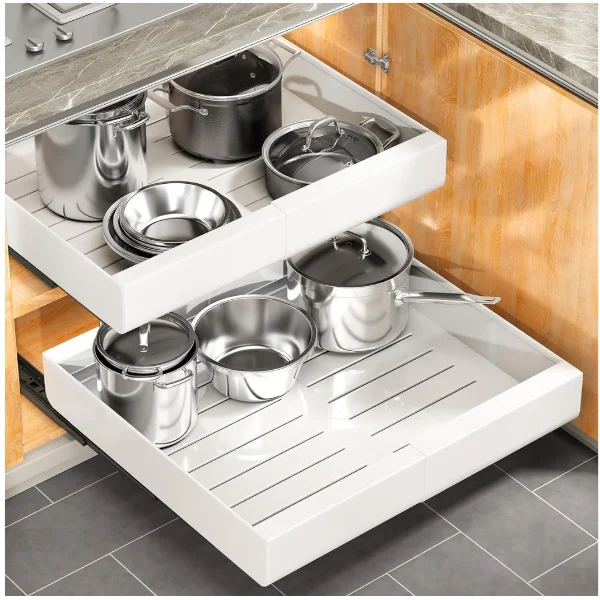
Heavy-Duty Sliding Pull Out Cabinet Organizer
Solution: Featuring commercial-grade ball-bearing glides, this sturdy steel pull-out drawer extends 100% forward, bringing heavy appliances directly to you for effortless access and instant returns.
- Supports up to 50 lbs of heavy kitchen appliances and cookware
- Full-extension ball-bearing slides pull all the way forward smoothly
- Simple base installation fits standard lower kitchen cabinets
How to Test an Appliance's Storage Location Before Buying Anything
Before purchasing new storage units, test your proposed setup with a zero-cost 48-hour experiment:
- Select One Countertop Offender: Pick one appliance (e.g., your toaster or blender) that currently lives on the counter.
- Designate a Cabinet Shelf: Clear a single dedicated spot in a lower or pantry cabinet.
- Move the Appliance Inside: Place the machine in the new spot and leave the countertop completely clear.
- Cook as Usual for Two Days: Each time you need the appliance, take it out, use it, and immediately put it back.
- Evaluate the Friction: Did returning it feel natural, or did you hesitate? If putting it away felt easy and you loved the open counter space, the parking spot is a permanent win.
Renter-Friendly Appliance Storage
Renters often cannot alter cabinet shelves or build custom appliance garages. Fortunately, several non-permanent storage strategies work exceptionally well:
- Dedicated Lower Cabinet Zones: Reserving one entire lower cabinet base strictly for 2 to 3 regular-use appliances.
- Shallow Pantry Shelving: Utilizing mid-height pantry shelves for lightweight machines. To understand how shelf depth impacts retrieval, explore our 5 pantry depth and visibility rules for small kitchens.
- Vertical Countertop Risers: Placing a compact wooden or metal riser in a dead corner to stack an espresso machine on top and tuck an electric kettle or coffee pods below.
- Freestanding Rolling Utility Carts: A slim rolling cart parked in an alcove creates an instant mobile baking or coffee station.
For more non-permanent tools that create functional space in tight floor plans, see our guide to 3 small kitchen upgrades that instantly create more space.
When Keeping an Appliance Out Is Actually Better
There is a dangerous organizing myth that a "successful" kitchen must feature empty, sterile surfaces. In reality, hiding an appliance that you use three times a day only creates unnecessary daily frustration.
Keeping an appliance on the counter makes total sense when:
- You use it multiple times every single day (e.g., your primary coffee maker or daily kettle).
- Moving it creates risk of drops, spills, or cord damage.
- The counter footprint is located outside your active cutting-board prep zone.
- Its presence genuinely saves you time without creating visual chaos.
The goal of organization is to serve your lifestyle, not to create a showroom. Leaving your most-used tools within arm's reach is smart kitchen ergonomics.
The 60-Second Appliance Test
To immediately reclaim prep space in your kitchen today, run this 60-second audit:
✓ Look at your counters: Count how many small appliances are currently resting on your surfaces.
✓ Identify the least-used machine: Find the one appliance you haven't used in the past 48 hours.
✓ Check its storage location: Move it into a clean, designated lower cabinet or pantry spot.
✓ Wipe down the cleared surface: Enjoy the immediate visual breathing room and expanded prep area.
✓ Test the return: The next time you use that machine, return it immediately to confirm its new home is easy to maintain.
Addressing these subtle habits helps you avoid the 5 kitchen organization mistakes making your kitchen feel smaller and keeps your counters open for effortless cooking.
The Rule for Small Kitchen Appliance Storage
When organizing a compact apartment kitchen, keep this central rule in mind:
"Not every appliance needs permanent counter space. Access should always match how often you use it."
The best appliance home is the one that makes your next meal effortless to start—and your prep counters effortless to clear. By aligning your storage with your actual cooking frequency, you transform a cramped, cluttered kitchen into a calm, functional workspace you love using every day.