When an apartment entryway feels uncomfortably tight, our natural instinct is to assume we simply have too many belongings or too little floor area. We look at scattered shoes, migrating mail, and overflowing jackets, and conclude that what the hall needs is a larger, more comprehensive storage unit.
Yet bringing in a traditional console table or deep storage bench often produces the exact opposite effect: the clutter might be contained, but the hallway instantly feels claustrophobic, dark, and difficult to pass through.
The core insight behind successful narrow entryway storage ideas is simple: storage capacity is not the only metric that matters. In a narrow hallway, storage depth is what makes or breaks the room.
A narrow entryway does not necessarily need less storage. In most homes, the existing storage is simply taking up too much physical depth. Organizing a narrow entrance is not about cramming the maximum volume of organizers along the baseboards; it is about choosing storage that solves your exact daily needs while preserving comfortable, unobstructed human movement.
Why Narrow Entryways Can Feel Smaller Than They Are
Perceived crowding in a hallway is rarely caused by square footage alone. Rather, it is dictated by the relationship between furniture projection and your usable walking corridor.
When you walk through a narrow hallway, your body needs a clear buffer on both sides to feel comfortable. When a bulky chest, wide bench, or deep shoe cabinet projects into that zone, several things happen simultaneously:
- Physical Compression: Your natural shoulder-width walking path is pinched, forcing you to turn sideways or walk cautiously when carrying groceries, bags, or coats.
- Visual Weight: Deep furniture casts shadows and blocks sightlines down the corridor, making the entire apartment entrance feel heavy and boxed in.
- Access Obstruction: Deeper pieces often create pinch points near room doors, closet openings, or light switches.
Understanding this balance means recognizing that a room's comfort is defined by its open circulation, not by how much furniture you can fit along its perimeter.
Storage Depth Matters More Than Storage Capacity
Most home organization advice focuses almost exclusively on capacity: How many pairs of shoes can this rack hold? How many drawers does this console provide?
In a spacious home, maximizing storage capacity makes sense. But in a narrow apartment hallway, every additional inch of furniture depth is stolen directly from your personal living space. Consider the trade-off:
- Deep Storage (14–18 inches): Holds massive volume, but cuts a narrow 36-inch hallway down to an awkward 18-to-22-inch crawlway.
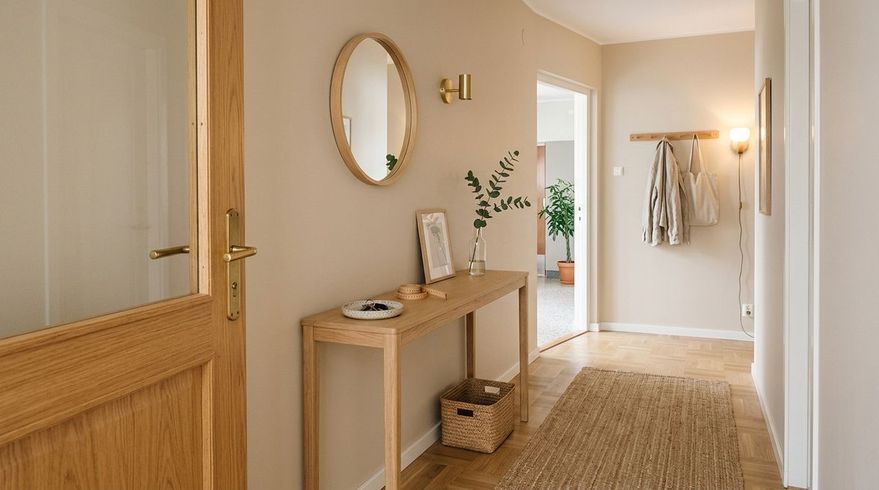
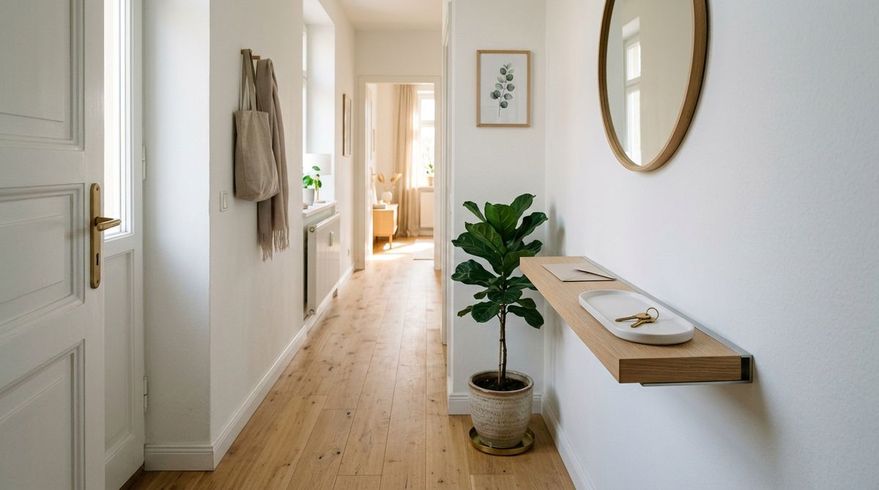
- Shallow Storage (4–8 inches): Holds precisely what your household uses every day, while leaving the walking path wide, open, and effortless to navigate.
More capacity is never an improvement if the piece makes entering and leaving your home feel like navigating an obstacle course. Storage should support your life, not dominate your floor plan.
What Makes Entryway Storage Feel Too Deep?
How do you know if your current entryway organizers are too deep for the space? Look for these practical everyday symptoms:
- Shoulder and Hip Brushing: You or your guests routinely brush against furniture edges or hanging coats when walking past.
- Awkward Transitional Movement: You have to step around furniture to unlock the front door, reach the intercom, or flip a light switch.
- Visual Blockades: Standing at the front door, you cannot see a clear, uninterrupted line into the main living area.
- Capacity Bloat: The storage piece is holding out-of-season coats, forgotten accessories, or items that belong in secondary closets simply because the deep shelves exist.
If you recognize any of these friction points, the issue is not your organizing discipline—it is the physical footprint of the furniture.
The Entryway Depth Test
To determine whether your entryway storage is working in harmony with your hallway, you do not need complex blueprints. You simply need to evaluate the space using a four-step framework:
MEASURE → CLEAR → COMPARE → CHOOSE
This method allows you to test real living conditions before buying new organizers, preventing costly mistakes and maintaining long-term spatial balance.
01 — MEASURE the Usable Space
Begin by observing the true usable width of your hallway without assuming a rigid numerical standard. Every apartment architecture is unique.
Rather than looking at raw wall-to-wall dimensions, observe the active operational corridor:
- How much width is required for two people to pass comfortably, or for one person carrying bags?
- Where do primary door swings and closet doors open?
- Where are the natural sightlines from the front door into the adjoining rooms?
To understand how natural foot traffic interacts with physical entry points throughout an apartment, our guide to the entryway traffic flow rule for a clutter-free apartment breaks down the essential movement zones that must remain clear.
02 — CLEAR the Deepest Storage Piece
The second step is a temporary diagnostic experiment. Take your deepest storage piece—whether it is a bulky bench, an oversized console, or a wide shoe rack—and temporarily move it out of the hallway into another room for just 24 hours.
During this test window, observe:
- How does the hallway feel when you walk through the front door?
- Does natural light travel farther down the corridor?
- Is entering with groceries or luggage significantly smoother?
- Which items actually needed to be in the hallway, and which were just stored there out of convenience?
This short experiment reveals the true baseline potential of your entryway when unburdened by deep furniture.
03 — COMPARE the Walkway
After experiencing the cleared hallway, compare the before and after states with critical honesty:
- Did the deep piece provide enough daily value to justify stealing half the walkway?
- Can the essential items (keys, daily shoes, mail) be handled with a solution that takes up a fraction of the depth?
In almost every small apartment, the answer is yes. Once you experience an open, unobstructed entrance, you realize that bulky floor storage was creating more daily stress than it was solving.
04 — CHOOSE the Shallowest Practical Solution
"Shallowest" does not mean buying the tiniest toy-like organizer on the market. It means choosing the least intrusive physical profile that completely solves your genuine daily requirement.
Match your storage solution to your household's actual volume:
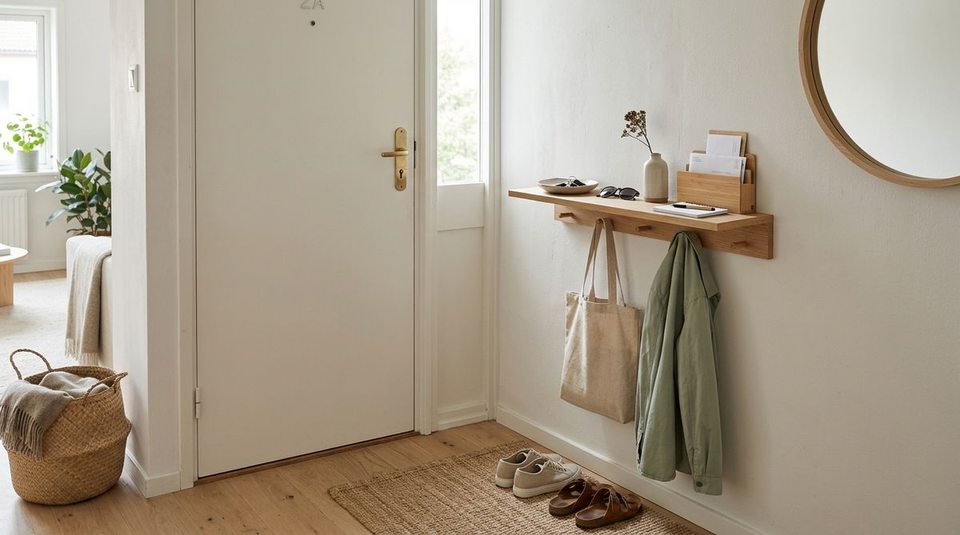
- For keys, mail, and sunglasses: A wall-mounted drop zone with shallow hooks and a slim shelf (projecting just 3 to 4 inches from the wall) completely solves daily pocket clutter without consuming any floor area.
- For wet umbrellas: A compact, ultra-narrow metal stand tucked into a corner catches runoff without blocking the main passage.
- For daily footwear: A vertical, ultra-slim tiered shoe rack or shallow cabinet that keeps daily pairs stacked close against the wall.
If pocket clutter and stray mail are your primary entrance pain points, an ultra-shallow wall unit provides dedicated organization while preserving 100% of your floor clearance.
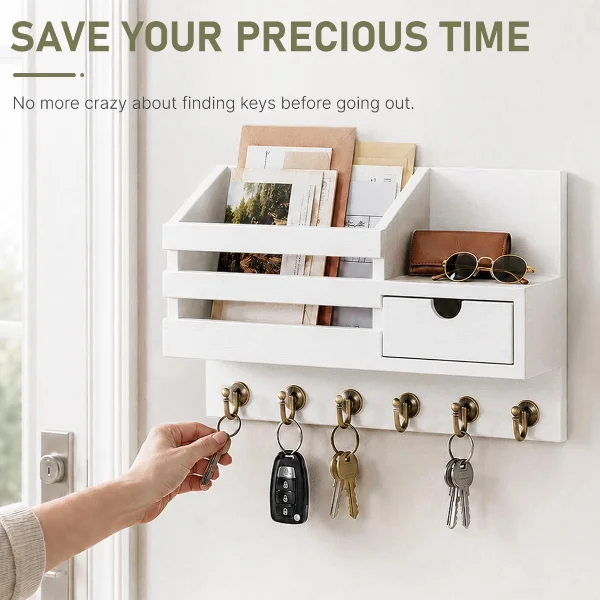
Decorative Key Holder & Mail Organizer
Solution: A shallow, wall-mounted paulownia wood organizer that catches incoming mail and holds 6 sets of keys within a zero-floor-footprint profile.
- Ultra-shallow depth preserves full hallway walking width
- 6 heavy-duty hooks keep keys, dog leashes, and badges organized
- Top display shelf holds sunglasses or small decor accents
When More Entryway Storage Actually Makes Sense
Good organization design is about balance, not dogmatic minimalism. There are circumstances where deeper storage in an entryway is entirely appropriate:
- Large Households with No Hall Closets: If four people live in an apartment with zero coat closets, dedicated high-capacity storage at the door is a necessity.
- Architectural Recesses: If your hallway features a natural alcove or recessed niche between structural walls, placing deeper furniture inside that niche will not intrude on the walkway.
- Wide Entryway Landings: If your entrance opens into a squarish foyer before narrowing into a corridor, utilizing the wider zone for deeper seating or cabinets makes practical sense.
The rule is not that deep storage is inherently bad. The rule is that depth must match the physical proportions of the space and the genuine volume needed.
When You Should NOT Add More Storage
Recognizing when to leave an entryway wall completely bare is a hallmark of thoughtful design. Avoid adding storage if it:
- Forces incoming guests to walk single-file immediately upon crossing the threshold.
- Interferes with the smooth swing of the entry door, closet doors, or bathroom doors.
- Adds capacity for items that are only used once a month (e.g., luggage, bulky guest bedding, out-of-season coats).
- Complicates cleaning by creating narrow, unreachable floor gaps behind furniture.
- Visually overwhelms the entrance, turning a welcoming arrival into a chaotic warehouse look.
Before adding new pieces, audit your current entrance to ensure you aren't storing things that don't belong there. Our guide on 7 things wasting space in your entryway right now helps identify the common space-wasters that should be relocated elsewhere in the home.
Renter-Friendly Ways to Improve a Narrow Entryway
Renters face unique constraints: they cannot tear down walls, build custom recessed cabinetry, or install heavy structural shelving. Fortunately, several non-permanent categories solve the depth problem effortlessly:
- Ultra-Slim Freestanding Consoles: Narrow tables designed with depths under 8 inches that lean or stand flush against baseboards without encroaching on walkways.
- Corner-Specific Low-Footprint Organizers: Taking advantage of dead corners with compact, geometric items like slim umbrella stands or corner coat trees.
- Non-Damaging Adhesive Wall Racks: Utilizing vertical surfaces for hanging hats, bags, and scarves using heavy-duty, removable adhesive hooks.
For dedicated wall-mounted strategies that maximize vertical surfaces without floor intrusion, explore our complete guide to entryway wall storage. When selecting individual organizers, our review of 5 entryway storage products that create more space highlights renter-friendly tools built specifically for tight dimensions.
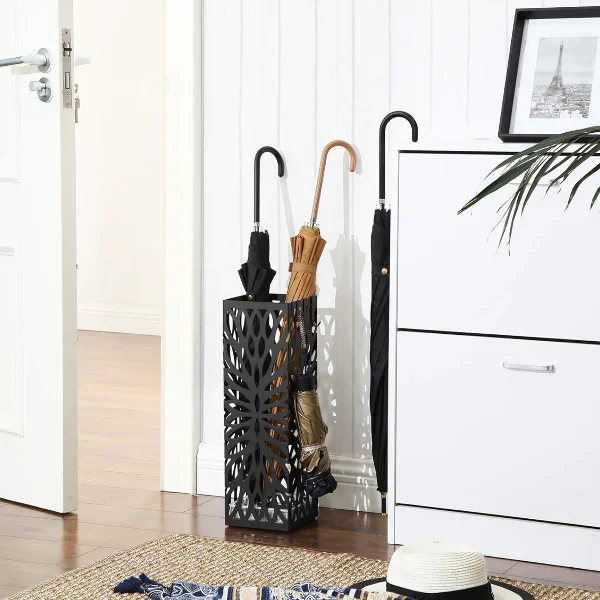
Slim Metal Umbrella Stand
Solution: A compact metal organizer with a 6.1-inch square footprint that fits neatly into unassigned corners while capturing water runoff in a removable drip tray.
- Compact 6.1-inch square profile fits into tight hallway corners
- Removable bottom drip tray protects hardwood and tile floors
- Includes 4 hooks for hanging compact folding umbrellas
How to Test Entryway Storage Before Buying It
Before purchasing any furniture piece or organizer online, run this simple physical simulation in your entryway:
- Identify the Exact Job: What specific items must this piece hold? (e.g., exactly 4 pairs of daily shoes and 2 sets of keys).
- Simulate the Depth: Use painter's tape on the floor or place cardboard boxes matching the piece's exact depth against the wall.
- Live with the Simulation for 48 Hours: Walk through the hallway carrying bags, take off your shoes, and open nearby doors.
- Assess the Friction: Did you bump into the cardboard? Did the hallway feel darker or cramped?
- Make the Decision: If the simulation caused friction, seek a shallower or wall-mounted alternative.
The 2-Minute Entryway Depth Reset
To quickly restore openness and function to your narrow entryway today, run through this simple reset:
✓ Identify the deepest piece: Spot the single piece of furniture projecting farthest into the walking path.
✓ Temporarily clear it: Remove non-essential items and observe how much width is reclaimed.
✓ Compare the walkway: Walk through normally and evaluate how much easier movement feels.
✓ Audit actual capacity needs: Relocate secondary items (seasonal gear, extra shoes) to bedroom closets.
✓ Choose based on depth AND function: Replace bulky floor storage with slim, shallow, or wall-mounted solutions.
The Rule for Narrow Entryway Storage
When organizing a compact home, remember this fundamental design truth:
"The best storage is not always the one that holds the most. It is the one that solves the problem without taking over the walkway."
More storage is not always the answer. In a narrow hallway, the truly transformative upgrade is often simply taking up less depth. By matching your storage profile to the natural proportions of your home, you create an entryway that welcomes you with ease, light, and effortless daily functionality.