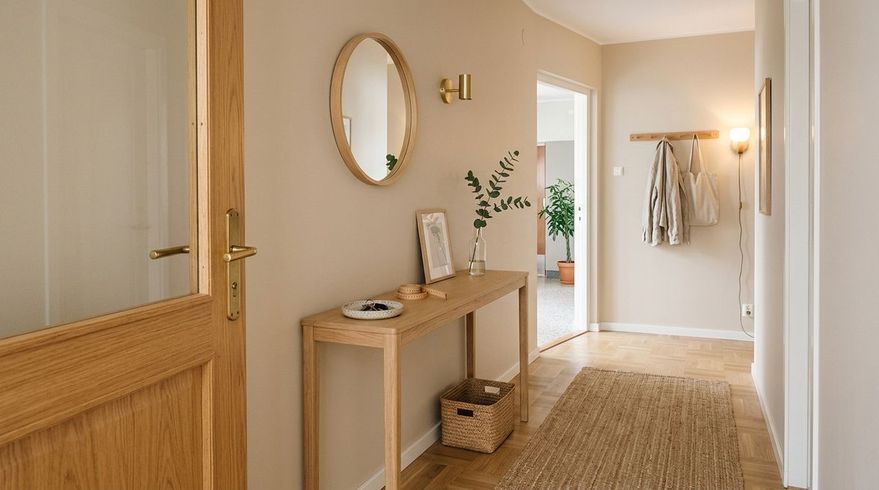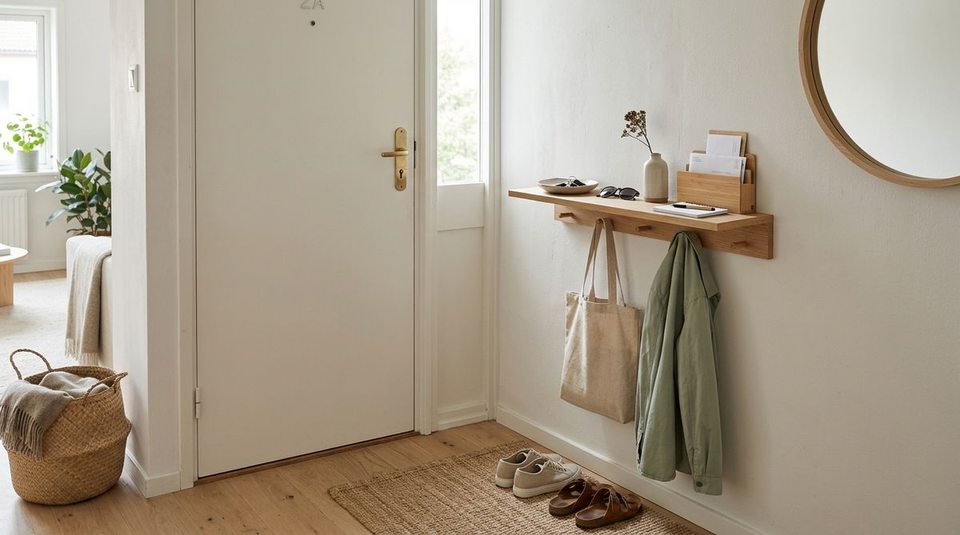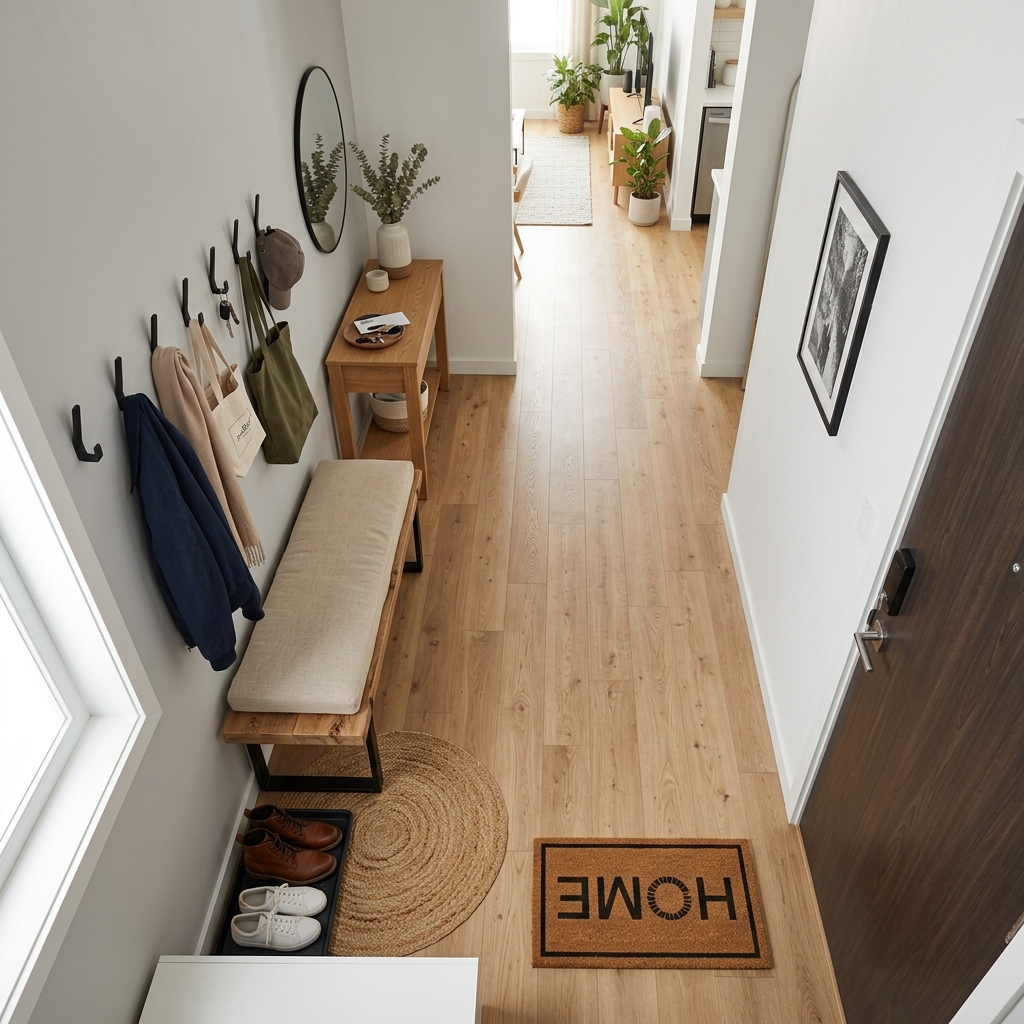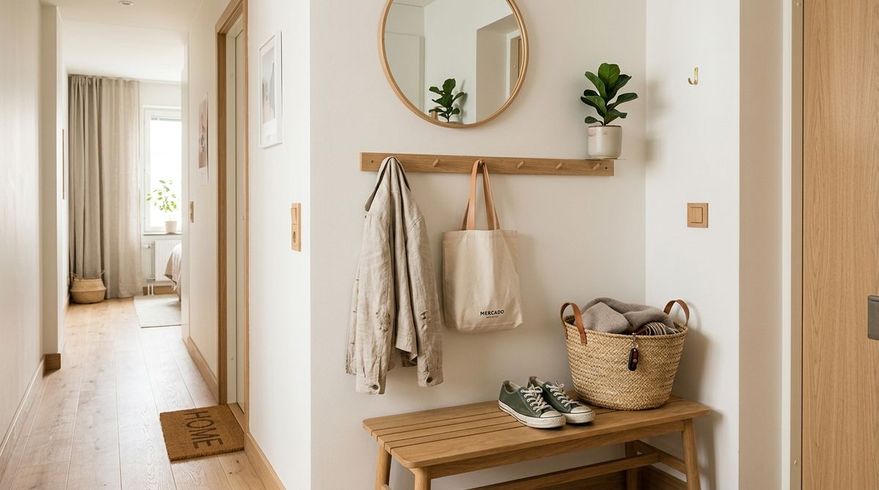
Sometimes a small apartment entryway feels completely overwhelmed and chaotic, even when every single coat is on a hook and every shoe is lined up on a rack.
You hang your summer tote bag next to a heavy winter parka. You squeeze light canvas sneakers in front of insulated snow boots from last February. A sun hat balances on top of a winter knit beanie basket. Everything is technically put away, yet the entryway feels crowded, visually noisy, and frustrating to navigate every time you walk out the door.
The problem in these situations is rarely a lack of wall hooks or shoe cubbies. The problem is inventory volume: your entryway is carrying too many seasons at once.
When multiple seasons occupy the same limited square footage, current-use items and inactive gear compete for the exact same prime space. The solution is not cramming more hooks onto your wall. The solution is managing seasonal capacity with a simple guiding principle: store what you need now; store elsewhere what you don't. By establishing an intuitive Sort → Rotate → Store → Repeat cycle, you can keep your front door calm, streamlined, and effortlessly functional throughout the entire year.
Why Seasonal Items Overload Small Entryways
In most apartments, the foyer or entry hall has strict physical constraints: limited wall width, tight walking corridors, and zero built-in closet depth.
When seasonal transitions are overlooked, four distinct friction points develop near the door:
- Visual Capacity Overload: Heavy wool coats and bulky winter boots take up three times the visual volume of spring windbreakers and sandals, making narrow hallways feel dark and cramped.
- Physical Access Bottlenecks: Reaching for your everyday jacket requires shoving past three heavy parkas that haven't been worn in months.
- Hook & Shelf Sagging: Overloading wall peg rails with year-round outerwear causes coats to fall onto the floor and damages wall anchors.
- Cognitive Friction: Leaving the apartment during a morning rush takes longer because you must visually filter through piles of irrelevant gear to find your daily keys, bag, and weather-appropriate layer.
Recognizing that seasonal congestion is a capacity management issue rather than an organizational failure is the first step toward reclaiming a peaceful home entrance.
What Should Actually Live Near the Door?
A functional entryway should serve as an efficient transition zone—not a permanent warehouse for everything your household owns. To maintain ease of movement, apply the rule of current-use priority.
Items that earn prime entryway real estate must meet four clear criteria:
- High Frequency: You reach for them on a daily or near-daily basis.
- Immediate Departure Need: Keys, daily wallet, everyday tote, or pet leash needed the exact second you step outside.
- Weather Appropriate: Specifically suited to the temperature and precipitation of the current week.
- Frictionless Placement: Easy to hang up or put away in under three seconds upon returning home.
Items that are worn only once a month, reserved for extreme weather anomalies, or clearly out of season belong in secondary closets or under-bed storage bins.
The Seasonal Entryway Rotation System
To prevent seasonal belongings from stacking up near your door, anchor your home routines to this straightforward 4-step framework:
SORT → ROTATE → STORE → REPEAT
This system requires zero elaborate sorting apps or permanent remodeling. It is a lightweight seasonal cadence designed to keep your home entrance responsive to how you actually live.
Step 1 — SORT What Belongs Near the Door
At the start of any weather transition, take five minutes to evaluate everything currently residing near the door. Divide your entryway items into three distinct tiers:
- Tier 1 (Everyday Essentials): The 1–2 coats, 1–2 pairs of shoes, and daily bag you wear constantly right now. These stay in prime access.
- Tier 2 (Occasional Current-Season Items): A compact umbrella, rain jacket, or light sweater needed during unpredictable weekly weather. These move to secondary hooks or an entryway basket.
- Tier 3 (Off-Season Inventory): Heavy winter parkas in May, or beach totes and flip-flops in November. These must exit the entryway completely.
Step 2 — ROTATE the Current Season Forward
Once you have identified off-season items, bring your current-season necessities into the most accessible positions:
- Spring & Summer Shift: Move lightweight windbreakers, sun hats, canvas totes, and breathable daily sneakers to your main eye-level wall hooks and lower bench shelves.
- Autumn & Winter Shift: Bring insulated jackets, warm beanies, gloves, and sturdy boots into the primary drop zone while clearing away sunhats and sandals.
For more architectural tips on maintaining clear corridors when outerwear changes size, see our guide on how to organize a narrow entryway without making it feel smaller.
Step 3 — STORE Off-Season Items Elsewhere
The most important rule of seasonal entryway management is simple:
"The entryway is not the storage room for every season."
Move your off-season gear into existing secondary storage throughout your home:
- Bedroom Closets: Hang off-season coats in the back of your clothes closet or inside breathable garment bags.
- Under-Bed Bins: Pack bulky winter scarves, thermal layers, or summer beach towels into fabric zippered bins under the mattress.
- High Shelf Storage: Place off-season footwear in uniform boxes on top closet shelves.
Using storage you already own ensures the rotation remains a simple habit rather than a shopping project.
Step 4 — REPEAT When the Household's Needs Change
Seasonal rotation is not an exhausting annual chore—it is an adaptable habit. When the temperature shifts in late spring or mid-autumn, repeat the cycle.
Because you are only moving a handful of jackets, accessories, and shoes, the entire rotation takes less than ten minutes. If a system requires moving heavy furniture or re-labeling dozens of bins every time the weather changes, it is too complicated to sustain.
How Much Should a Small Entryway Hold?
There is no universal number of coats or shoes that applies to every home. The ideal capacity depends on your household size, local climate variability, and apartment layout.
Instead of aiming for an arbitrary count, follow the rule: hold what earns prime access.
If removing a coat from a hook pulls two other jackets down with it, your hooks are over capacity. If shoes are stacked two-deep on a floor mat, you have exceeded your entryway's natural inventory limit. Let physical ease of access dictate your capacity.
Create a "Current Season" Priority
Establish an intuitive physical hierarchy inside your entryway footprint:
| Priority Tier | Item Types | Ideal Location |
|---|---|---|
| Prime Access | Active daily coat, current shoes, keys, everyday bag | Eye-level wall hooks, open bench surface, key dish |
| Secondary Access | Compact umbrella, light backup layer, sunglasses, lint roller | Enclosed bench cubby, side basket, lower hook |
| Elsewhere | Off-season parkas, snow boots, beach gear, backup coats | Bedroom closet, under-bed storage, top shelf bins |
For more strategies on keeping daily movement frictionless, read our guide to the entryway traffic flow rule for a clutter-free apartment.
What NOT to Store in the Entryway Year-Round
To protect your entryway from perpetual clutter, maintain a strict boundary against these chronic space-wasters:
- Guest Outerwear Backups: Store extra guest jackets in a secondary closet until guests actually arrive.
- Full Footwear Collections: Your entire 15-pair shoe wardrobe does not belong by the front door; keep only active pairs out.
- Sports & Specialized Hobby Gear: Ski helmets, hiking poles, or beach umbrellas should be archived in utility storage.
- Inactive Seasonal Accessories: Never leave winter beanies in entryway baskets through July.
For a detailed breakdown of items that frequently hijack front halls, explore our checklist of 7 things wasting space in your entryway right now.
How to Rotate Without Buying New Organizers
You do not need to buy specialized organizing furniture to start managing seasonal inventory. You can execute a complete seasonal rotation today using zero-cost steps:
- Empty the Entryway: Remove all jackets, shoes, and accessories from hooks and benches onto your living room rug.
- Filter for the Next 7 Days: Select only what you will realistically wear in the upcoming week's forecast.
- Return the Active Items: Hang only the active jackets and place only the active shoes back in the entryway.
- Relocate the Rest: Carry the remaining off-season items directly to your bedroom closet or under-bed bins.
- Observe the Difference: Notice how much wider, brighter, and calmer your front entrance feels immediately.
The 60-Second Seasonal Entryway Check
Whenever you notice your front door feeling crowded, run through this 60-second diagnostic check:
✓ Are there items on hooks that haven't been worn in two weeks?
✓ Are heavy winter layers lingering into mild spring weather?
✓ Are inactive shoes crowding the floor mat?
✓ Can I grab my daily jacket without catching another coat?
If you answer "yes" to any of the first three questions, execute a rapid Sort → Rotate → Store → Repeat reset.
How to Prevent Seasonal Overflow
Maintaining a streamlined entryway requires simple operational rules:
- Rule 1: Current Season Priority: Only current weather items receive prime hanging space.
- Rule 2: One-In, One-Out on Hooks: If you bring home a new seasonal coat, rotate an older one into secondary storage.
- Rule 3: Clean Boundaries: The floor beneath wall hooks must remain clear of loose piles.
- Rule 4: Rotate Before Buying Storage: Always reduce seasonal inventory before shopping for larger furniture.
Renter-Friendly Seasonal Entryway Organization
In rental apartments, seasonal organization should rely on modular, damage-free setups that adapt easily to changing needs:
- Slim Multi-Tier Bench Seating: A narrow wooden bench provides a comfortable place to put on shoes while offering open lower shelves for daily footwear.
- Adhesive Heavy-Duty Hooks: For renters without permission to drill, heavy-duty removable wall hooks hold lightweight jackets and canvas totes securely.
- Lidded Woven Baskets: A clean basket tucked under a bench neatly conceals current-season accessories like sunhats or knit scarves.
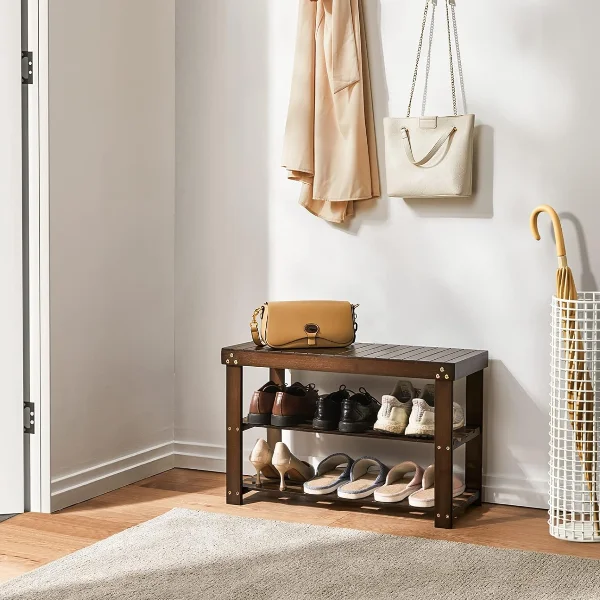
Entryway Shoe Storage Bench
Solution: A compact, sturdy bamboo bench that offers comfortable seating on top with open lower shelving to keep active seasonal footwear organized and off the floor.
- Compact footprint fits comfortably in narrow rental apartment hallways
- Dual lower tiers keep current-season daily footwear neat and accessible
- Provides a dedicated sitting area for putting on and taking off shoes
For more space-saving ideas to optimize your entrance, check out our full collection of entryway organization guides.
When Seasonal Rotation Is NOT Necessary
Honest home organization means recognizing when a system is unnecessary. Seasonal rotation may not be needed if:
- You live in a climate with consistent year-round temperatures where outerwear needs never change.
- You live alone and own only two jackets and three pairs of shoes total.
- Your apartment features a spacious built-in entryway closet capable of holding all seasons without crowding.
The goal is never to enforce arbitrary routines, but to eliminate real daily friction when space is limited.
Give Your Entryway Less to Manage
A small apartment entryway does not need to store every coat, boot, and accessory your household owns throughout the year. Its purpose is to support what you actually need the moment you walk through the door today.
By practicing the Sort → Rotate → Store → Repeat routine and giving current-season essentials prime access, you free your entrance from seasonal clutter, preserve open walkway corridors, and create a calm, welcoming entrance every time you return home.